
A Scent Museum as Brand Asset for Pharmacy Retail: A Buyer's Checklist
A supplier's scent museum is a brand asset only when it is read as evidence rather than as atmosphere. For a pharmacy own-label fragrance project the visit earns its afternoon because it shows how a house explains scent to people who are not perfumers, and how it thinks about materials, display and education; none of that replaces factory checks on formulation, filling, quality records and claim documentation. Walk the museum with a checklist, write down what it demonstrates, and move everything it cannot demonstrate onto the audit list.
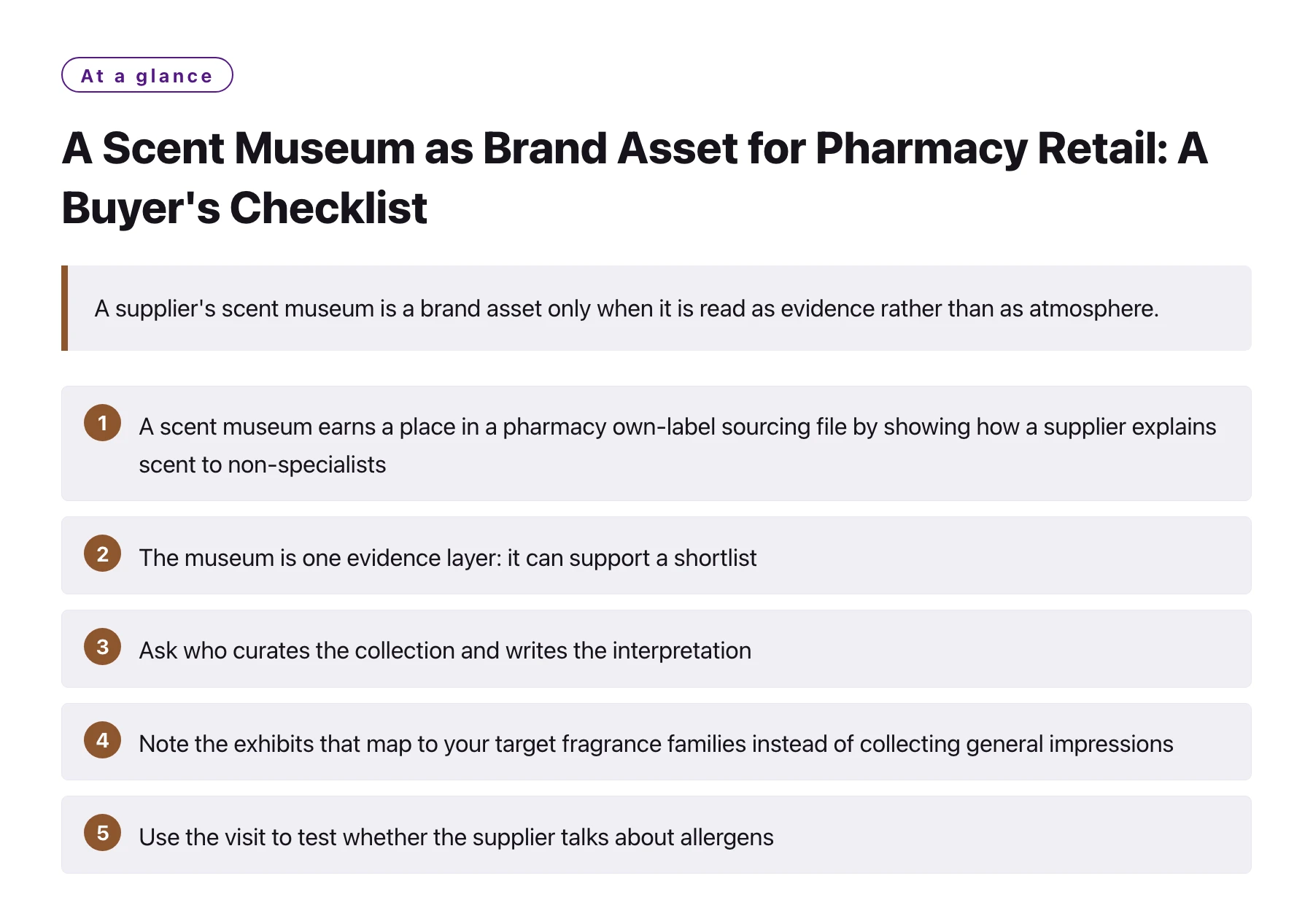
Key takeaways
- A scent museum earns a place in a pharmacy own-label sourcing file by showing how a supplier explains scent to non-specialists, which is close to what counter staff must do every day.
- The museum is one evidence layer: it can support a shortlist, but formulation, filling, quality systems and claims still have to be verified at the factory.
- Ask who curates the collection and writes the interpretation, because a supplier that can explain its own choices is easier to brief and easier to hold to a standard.
- Note the exhibits that map to your target fragrance families instead of collecting general impressions, and photograph the labels that name materials.
- Use the visit to test whether the supplier talks about allergens, dosage and safe use in plain language, since that is the language pharmacy buyers and counter teams need.
- Anything the museum cannot prove becomes a written question for the next supplier meeting rather than an assumption in the sourcing file.
Pharmacy chains build own-label ranges for a reason: the shopper already trusts the shelf, and a private label converts that trust into margin. Fragrance is one of the harder categories to add, because scent is judged in seconds and returns are expensive. A supplier that can demonstrate how it thinks about scent is therefore interesting, and several Chinese manufacturers now run museums or experience centres that do exactly that.
The problem is that a well-built museum is also a very good sales room. It creates confidence quickly, and confidence is not the same as evidence. Buyers who come back from a visit with photographs and a good feeling, but without a list of verified facts, tend to discover the gaps later, usually when a claim on the pack cannot be supported or when the first bulk batch drifts from the approved sample.
This checklist is written for the person assembling a pharmacy own-label fragrance line. It treats the museum as a specific kind of evidence, describes what it can and cannot prove, and keeps the rest of the due diligence where it belongs.
What a museum visit proves that a meeting cannot
A scent museum is a public argument about what matters in fragrance. The way materials are grouped, the way a period or a region is narrated, and the way visitors are invited to smell rather than read all reveal how a house organises its knowledge. For a pharmacy own-label buyer this matters more than it first appears, because the pharmacy shopper usually needs scent explained simply and honestly, and the supplier who can explain it is the supplier who can also help train a counter team.
A museum also demonstrates whether scent is treated as a cultural object or only as a product. The International Council of Museums describes museums as institutions that acquire, conserve and exhibit heritage for society, and the interpretation that sits alongside a collection is part of that work, not decoration. A supplier that has invested in interpretation has usually invested in the vocabulary your brief will be written in. [1]
What the visit does not prove is capability. A beautifully explained collection says nothing directly about compounding accuracy, fill weight control, allergen documentation or the ability to repeat a batch. Museums Association guidance on how museums present and evaluate their work is a useful reminder here: presentation and process are separate claims, and only one of them is being shown to you on the day. [2]
Read it as a supplier's argument, not as a certificate
Treat every wall text as a claim. A claim that raw materials are traced is testable at the factory with lot records. A claim that a scent family is understood in depth is testable with a short brief and a sample round. The museum gives you the claim for free, and the meeting after the visit is where you ask for the evidence.
The checklist: what to look at, what it proves, how to verify
| What to look at in the museum | What it can prove | How to verify it afterwards |
|---|---|---|
| Who curated the collection and who wrote the interpretation | Whether the house can articulate scent choices in language a non-specialist can follow | Ask for the brief-to-sample route used on a previous own-label project |
| How materials are grouped, by family, origin or era | Whether the supplier thinks in fragrance families, which is the vocabulary your brief needs | Send a two-line brief in one family and judge the first sample round |
| Whether the exhibition discusses allergens, dosage or safe use | Whether compliance language is part of the house's normal vocabulary | Request the current documentation and safety sheets for a comparable formula |
| Whether the museum runs workshops, courses or staff sessions | Whether the supplier can train your pharmacy counter team, not only your buyers | Ask for the training outline, format and who delivers it |
| How the space handles display, storage and light | Whether the supplier thinks about how scent behaves on a shelf and over time | Compare this with the bulk storage and retained-sample conditions at the factory |
| Whether the visit ends with an offer of documents or only of samples | Whether the supplier's default move is evidence or enthusiasm | Score the answer in your supplier file and revisit it at the audit stage |
A checklist turns an enjoyable visit into comparable notes, which is the only form in which a museum visit can influence a sourcing decision with a pharmacy retailer watching the paperwork.
Where the museum stops being evidence
Three questions are outside the museum's reach: can this supplier repeat a scent at volume, can it document what it puts in the bottle, and can it deliver against a dated launch. None of them can be answered by walking a gallery, and a buyer who lets the visit substitute for the answers is buying a story. The company behind the museum is still a manufacturer, and the same company that built the exhibition also runs filling lines that have to be checked.
The practical way to keep the two apart is to schedule the factory day and the museum day together but score them separately. On the factory day you are looking for records and process; on the museum day you are looking for vocabulary, education and intent. A supplier such as the museum of scent in Guangzhou makes that separation easy because the exhibition and the production site are part of the same organisation, and you can see both sides of the same claim.
For a pharmacy channel specifically, the education side of a museum is worth more than it is in a department store. Own-label fragrance sold next to cough syrup and sunscreen is bought with the help of staff, and staff need a short, accurate way to describe a scent, its strength and its intended use. A museum that has already solved that translation problem is a genuinely useful partner, provided the rest of the file holds up.
Write the museum notes the same day. Memory flattens a visit into a general impression within a week, and a general impression is the easiest thing in the world for a supplier to manage on the next call. Dated, specific notes with two or three open questions attached are much harder to smooth over.
Attaching the visit to the rest of the sourcing file
The end product of a museum visit should be three additions to the sourcing file: a short paragraph on the supplier's approach to scent and education, a list of claims that now need documentary support, and two or three suppliers to keep in the round. It should not be a review score on its own, and it should never be the reason a visit replaces a sample round.
Buyers who run several own-label categories for a pharmacy group often find that the museum visit becomes the moment when the internal pitch is made easier. Photography, a short video and two paragraphs on how the range would be explained at the counter give the category team something concrete to discuss. That is a legitimate use of the visit, as long as the product claims on the same slide are already backed by documents.
Keep the file honest by separating the two kinds of assurance. brands Xuelei has manufactured for is the sort of page that speaks to experience, and experience is worth something in a supplier shortlist; the museum speaks to intent and articulation. Neither one stands in for a retained sample, an allergen declaration or a signed specification, and a pharmacy retailer will ask for those regardless of how impressive the origin story is. Pharmacy is a regulated retail channel in most markets, and the obligations attached to the pack sit with the brand named on it rather than with the supplier behind it. [3]
If the visit does lead somewhere, the next step is usually a short development brief rather than a full tender. A supplier that has already shown how it explains scent is a reasonable candidate for private label fragrance production, and the first sample round is where the museum's claims either survive or quietly disappear.
Sources
- ICOM — International Council of Museums —— The international organisation representing museums; publishes the ICOM museum definition and professional standards for museum practice.
- Museums Association —— A professional body for museums, publishing guidance and research on museum practice and visitor experience.
- European Commission: Cosmetics in the EU —— The European Commission's overview of EU cosmetics rules, including the responsible person, product information file and safety report requirements.
Frequently asked questions
Does a supplier's fragrance museum prove it is a good manufacturer?
No. It proves the supplier can present and explain scent, which is a real but different capability. Formulation accuracy, fill control, documentation and repeatability are verified at the factory with records and sample rounds.
How long should a pharmacy own-label buyer spend on a museum visit?
Half a day is usually enough to walk the collection, ask about curation and training, and hold the follow-up meeting. The value comes from specific notes rather than from time spent, so a focused two hours plus a discussion often beats a long tour.
What should I ask about staff training for a pharmacy counter team?
Ask who delivers the training, whether it is in person or online, how long it takes, and whether it covers strength, intended use and the claims on the pack. A short outline you can read before the visit is a reasonable request.
Is a museum visit a substitute for a sample round?
No. A sample round is the only way to judge whether the supplier can turn your brief into a scent you can sell. The visit can shorten the brief because the vocabulary is shared, but it cannot replace the sample.
Can a museum visit help with the internal pharmacy retail pitch?
Yes, if the material is specific. Photographs of relevant fragrance families and a short explanation of how the range would be described at the counter give the category team something concrete, provided the product claims alongside it are already documented.
One long read in your inbox each Wednesday.
Reviews, interviews, and festival dispatches from working critics — read by 42,800+ subscribers. Free, no tracking.